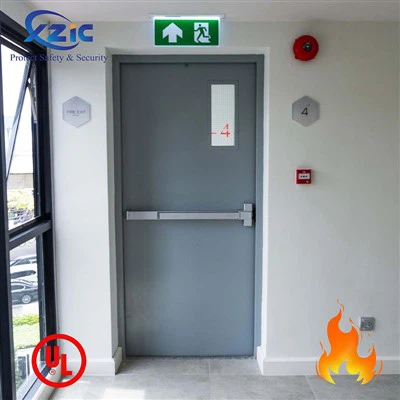
We see fire doors in many places. There are many types of fire doors on the market. What are the differences between wooden fire doors and steel fire doors?
Differences between Wooden and Steel Fire Doors
1. Material differences: Wooden fire doors are made of wood. Generally, the door frame, door jamb, and door panel are made of wood, and their fire resistance performance meets relevant regulations.
Steel fire doors are made of steel. In addition to the door frame, the frame, panel, and filler materials are required to be non-toxic and environmentally friendly fire-resistant and heat-insulating materials. They are then assembled with hardware fittings to form a fire-resistant door that meets the regulations.
2. Installation differences: When installing wooden fire doors, the door frame specifications must be 20 mm smaller than the opening. The bottom of the door frame should be embedded 20 mm into the ground. The door frame must be firmly fixed to the wall. Attention should be paid to ensuring the frame is straight and at right angles, preventing warping. There should be at least three fixing points on each side of the door frame, and the spacing should not exceed 800 mm.
When installing steel fire doors, the bending deformation of the door frame should be considered. Wooden supports are needed in the width direction of the door frame. The door frame should be embedded 20 mm into the ground. The parts embedded in the door frame and the wall should be welded. The wall above the door frame should be opened and filled with concrete mixed with cement, sand, and expanded perlite. It can be used after curing.
3. Performance requirements differences: The door frame and thickness of wooden fire doors must exceed 50 mm. The door leaf must be connected by double tenon joints. When splicing the door frame and door leaf, the tenon and mortise should be tightly fitted, glued together, and fixed with glue wedges.
The overlap between the door leaf and the door frame of steel fire doors should not be less than 10 mm, and the gap between the door leaf and the door frame on both sides should not exceed 4 mm. The gap should not be too large after installation. Otherwise, the sealing performance will be affected, and fire and smoke cannot be effectively contained.