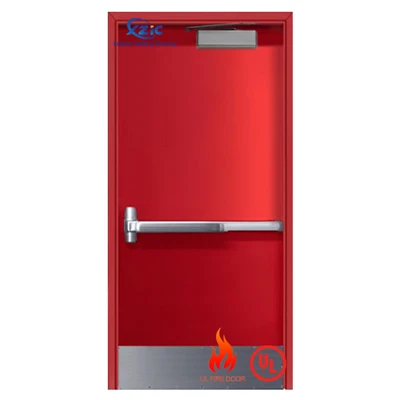
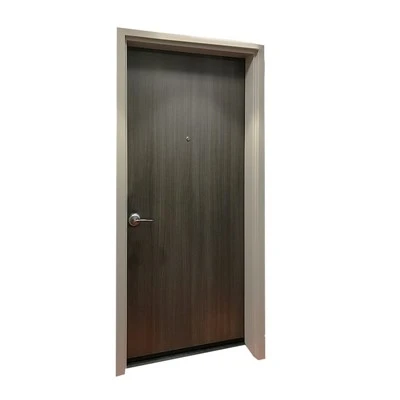
Steel fire doors are one of the most common types of fire doors in the North American market and international projects that adopt UL standards. Buyers and architects typically focus on its fire resistance rating (30 minutes, 60 minutes, 90 minutes, etc.), but another equally important performance indicator is often overlooked - thermal performance and insulation value.
A steel fireproof door should not only be able to block flames in a fire, but also limit the transfer of heat from the fire side to the non fire side. This is not only related to the safety of evacuees on evacuation routes - if the temperature on the back of the door is too high, the radiation heat itself may cause harm - but also to the energy efficiency in the daily operation of the building. This article will systematically analyze the thermal performance requirements, testing standards, and how to evaluate the insulation value of steel fire doors under the UL standard system.
Temperature rise level: Core indicator of thermal insulation performance under UL standards
In the UL fire door system, in addition to the fire resistance rating measured in minutes (such as 60 minutes, 90 minutes), some fire doors are also labeled with a Temperature Rise Rating. The temperature rise level measures the increase in surface temperature on the non fire side of a fire door relative to the ambient temperature during the fire exposure period.
Thermal Performance Assessment in UL 10C Positive Pressure Test
UL 10C positive pressure testing is currently the mainstream testing standard required by IBC. During the testing process, the fire door components were exposed to extreme high temperatures of up to 1925 ° F (approximately 1052 ° C). For fire doors with temperature rise level requirements, testers will place thermocouples at multiple locations on the non fire side of the door leaf:
·At least three measurement points
·Install at least one thermocouple in every 16 square feet area
·Thermocouples shall not be placed above glass panels, reinforcements, or within 12 inches of the edge of the door leaf
Only fire doors that have passed the triple assessment of temperature rise limitation, integrity maintenance, and hose water flow testing can obtain the corresponding UL certification label. The label will indicate both the fire resistance rating and temperature rise rating.
Structural Design and Thermal Performance of Steel Fire Doors
The key to why steel fire doors can meet both fire resistance and insulation requirements is their multi-layer composite structure. A typical UL certified steel fireproof door consists of the following parts:
1. Steel panel
High strength cold-rolled steel plates are used, and the thickness depends on the fire rating - the higher the rating, the thicker the steel plate required. Steel panels provide structural strength and impact resistance.
2. Thermal insulation core material
The insulation material filled inside the door leaf is the core that determines its thermal performance. Common materials include:
Flame retardant honeycomb, perlite board, mineral wool, etc
The common characteristics of these insulation core materials are: non combustible, low thermal conductivity, and the ability to effectively absorb and dissipate heat in a fire, delaying the conduction of heat to the non fire side.
Quantification of insulation value: R value and U value
For purchasers and architects who are concerned about building energy efficiency, the thermal insulation performance of fire doors can be quantified by two indicators:
R-value (thermal resistance): measures the ability of a material to resist heat flow. The higher the R value, the better the insulation performance. The R value of steel fireproof doors using mineral wool core material can reach 4.5 to 5.3.
U-value (heat transfer coefficient): measures the rate at which heat passes through a material. The lower the U value, the better the insulation performance. Some high-performance fire doors have a U value as low as 1.5 W/m ² K.
It should be noted that the thermal performance of fire doors depends not only on the core material, but also on the sealing between the door frame and the door leaf. Air leakage will significantly reduce the overall thermal performance. Advanced sealing systems can significantly reduce air leakage and heat transfer.
The practical significance of temperature rise level: why it is important
For building owners and facility managers, understanding the practical significance of temperature rise levels is crucial:
Evacuation route safety: In evacuation routes such as stairwells, evacuees may need to pass through the area where fire doors are located. If the temperature on the back of the door is too high, radiation heat can cause serious damage. The 450 ° F temperature rise rating is the minimum requirement for IBC for stairwell fire doors.
Limitations of fire-resistant glass: For 60 minute and 90 minute temperature rise fire-resistant doors, the area of fire-resistant glass is limited to no more than 100 square inches. This is because ordinary fire-resistant glass cannot effectively block radiative heat transfer. Glass exceeding this area requires the use of Fire Resistive Glazing glass.
Label recognition: UL certified temperature rise fire doors will clearly indicate the temperature rise level on their labels. Careful verification of label information should be carried out during procurement.
Thermal Performance and Building Energy Efficiency
In addition to its thermal insulation performance in fires, the thermal performance of steel fire doors also directly affects the daily energy consumption of buildings. In buildings that require insulation or cooling, the heat transfer of the door is one of the important ways of energy loss.
Fire doors made of high-density mineral wool or pearl core materials not only provide excellent insulation protection in case of fire, but also reduce air conditioning energy consumption in daily use. Some products have been recognized by the green building certification system and can contribute points to projects such as LEED.
Procurement suggestion: How to evaluate the thermal performance of steel fireproof doors
When purchasing steel fire doors for a project, it is recommended to evaluate their thermal performance from the following dimensions:
1. Confirm temperature rise level requirements: Based on the project location and IBC specifications, confirm whether a temperature rise level is required and the specific level (250 ° F, 450 ° F, or 650 ° F)
2. Check the UL certification label: Confirm whether the UL label on the door leaf indicates both the fire resistance rating and temperature rise rating
3. Understand the type of core material: Confirm with the supplier the type of insulation material (mineral wool, perlite, or vermiculite) filled inside the door leaf and its thermal conductivity
4. Evaluate sealing performance: The sealing system between the door frame and the door leaf directly affects the thermal performance, and the sealing strip configuration should be confirmed
5. Consider glass configuration: If an observation window is required, confirm whether the glass area is within the UL allowable range and whether fire-resistant and heat-insulating glass is used
Conclusion
The thermal performance and insulation value of steel fireproof doors are equally important performance dimensions under the UL standard system as the fire resistance rating. It is related to the safety of evacuees in fire evacuation routes and the energy efficiency of daily building operations.
From strict temperature control of 250 ° F, to an R value of 4.5 for mineral wool core materials, to thermocouple measurements in UL 10C positive pressure testing - behind every number lies a rigorous commitment to life safety and building performance. When purchasing steel fire doors, please pay attention to the temperature rise level and insulation core material to ensure that you choose not only "fire-resistant" doors, but also "heat-insulating" doors.