


If you’ve ever walked through a commercial building, a school, a hospital, or a multi-unit apartment complex, you’ve probably passed a steel fire door without even noticing it—until that door is needed most. Steel fire doors are the unsung heroes of passive fire protection, designed to slow the spread of flames, smoke, and toxic gases long enough for occupants to evacuate and first responders to intervene. But here’s a question I get all the time as a steel fire door supplier: “What makes a steel fire door actually fire-resistant, not just a regular metal door?” The answer lies in a specific, often misunderstood component: the fire-retardant coating applied to its surface.
Let’s break this down simply, no overly jargon-heavy explanations, because when your livelihood depends on fire safety, you need clarity, not confusion. First, it’s important to distinguish a standard steel door from a fire-rated steel door. A standard steel door is made of thin sheet metal, welded or bolted together, and primed just to prevent rust. A fire-rated steel door, like the ones we manufacture, is engineered to meet strict testing standards (usually UL, NFPA, or CAN/ULC) that require it to withstand exposure to extreme heat for a set period—60, 90, 120, or even 180 minutes, depending on the building’s needs. That endurance doesn’t come from steel alone; steel, while non-combustible, expands and loses structural integrity at temperatures over 1,000°F. That’s where fire-retardant coatings step in to stabilize the door and maintain its protective function during a fire.
So, what exactly is a fire-retardant coating for steel fire doors? It’s a specialized layer, often water-based or solvent-based, formulated with chemicals that react to high heat in specific ways. The core purpose of this coating is two-fold: first, to insulate the steel door from extreme temperatures, and second, to prevent the door from warping, expanding, or breaking apart when exposed to fire. Unlike regular paint, which is designed to look good and protect against minor scratches or rust, fire-retardant coatings are tested repeatedly to perform under the exact conditions a door would face during a real emergency.
There are two main types of fire-retardant coatings used on steel fire doors, and we’ll cover both because each serves a unique purpose in our product lines. The first is intumescent coating, the most common type for commercial steel fire doors. When intumescent coating is heated, it doesn’t just melt or burn—it swells into a thick, carbonaceous char. Think of this char like a dense, insulating sponge that forms a barrier between the hot fire and the steel underneath. That char slows heat transfer so drastically that the steel door stays cool enough to retain its structural strength, even when the fire on the other side is reaching 2,000°F. This is why intumescent coating is ideal for doors that need medium to long fire resistance, like our [Fire Rated Door Steel Door] models, which are used in stairwells, elevator lobbies, and corridor walls.
The second type is cementitious coating, a thicker, harder layer made from cement, fillers, and fire-resistant additives. Cementitious coatings are applied in thicker coats (sometimes up to a quarter of an inch) and work by their natural insulating properties—they don’t intumesce, but they absorb heat and slow it down from reaching the steel. These coatings are often used for doors that need very long fire ratings, like our 180-minute models, because their dense structure can endure prolonged heat exposure without breaking down. The tradeoff is that cementitious coating makes the door slightly heavier, but for applications where maximum endurance is required, that tradeoff is well worth it.
Now, let’s talk about how this coating is applied, because it’s not a “one-size-fits-all” spray job. As a steel fire door supplier, we follow strict application guidelines to ensure the coating works as intended. First, the steel door is cleaned thoroughly to remove any oil, rust, or debris—even a tiny speck of grease can break the coating’s adhesion, creating a weak spot that could fail during a fire. Then, a high-quality primer is applied to the steel to help the coating stick and prevent corrosion, which is a must even for fire-rated doors (corroded steel is weak steel).
Next, the fire-retardant coating is applied either by spray, brush, or trowel, depending on the type. Intumescent coating is usually spray-applied in thin, even layers to avoid runs or uneven coverage, because too thick a layer could crack when it swells during a fire. Cementitious coating, being thicker, is often troweled on to ensure full, uniform coverage across the entire door face, edges, and frame—any gap in the coating, no matter how small, is a potential weak point where fire could seep through. After application, the coating cures in a temperature-controlled environment for several days, not just a few hours, because curing time directly impacts its ability to react to heat. We test every batch of coating on our doors to confirm that the thickness matches the required fire rating, so our customers never have to guess if their door will perform when it matters.
But here’s a critical point: fire-retardant coating isn’t set-it-and-forget-it. Over time, especially in harsh environments like industrial facilities, parking garages, or outdoor applications, the coating can chip, crack, or wear down. That’s why regular inspections are required for fire-rated doors, per NFPA 80 standards, to make sure the coating is intact. We always advise our customers to have a qualified technician check their steel fire doors every 12 months, and if any damage to the coating is found, to repair or reapply it immediately—because a damaged coating is like a seatbelt with a fray; it’s only effective if it’s whole.
Let’s tie this back to real-world use cases, because I know our customers care about how this works for their specific buildings. For example, a K-12 school needs fire doors that are safe for students, easy to maintain, and reliable for 60 or 90 minutes of fire resistance. Our [Fire Proof Door Approved Fire Resistant Door Fireproof Steel School] models use intumescent coating because it’s smooth, easy to wipe down (important for hygiene in schools), and meets all safety standards for educational facilities. On the other end, a high-rise office building might need doors with 180-minute fire ratings to slow fire spread across multiple floors, so our 180-minute galvanized steel doors, which use a durable cementitious coating, are the perfect fit. These doors are also galvanized, so the coating is protected from rust, which is a big plus for buildings in coastal areas or with high humidity.
You might be wondering, do all steel fire doors use fire-retardant coating? The short answer is yes—any door that carries a fire rating from a recognized testing agency will have a tested and approved fire-retardant coating. Without it, even a thick steel door won’t meet the required fire resistance time. Some people ask us, “Can’t I just use regular steel without coating?” But as I mentioned earlier, steel expands when heated at over 1,000°F. If a steel door didn’t have a fire-retardant coating, it would warp, bow, or collapse within 10 or 15 minutes of a fire, rather than holding strong for 60, 90, or more minutes. That coating is the difference between a door that’s a fire hazard and one that’s a fire barrier.
Another common question: does the coating affect the door’s appearance? It depends on the type. Intumescent coating can be painted over with a regular topcoat, so you can match the door to the building’s interior, which is great for commercial spaces that want a cohesive look. Cementitious coating, on the other hand, has a slightly textured finish, so it’s usually left as is or painted with a heavy-duty paint designed to adhere to it. We offer both options, because we know our customers care about both safety and aesthetics.
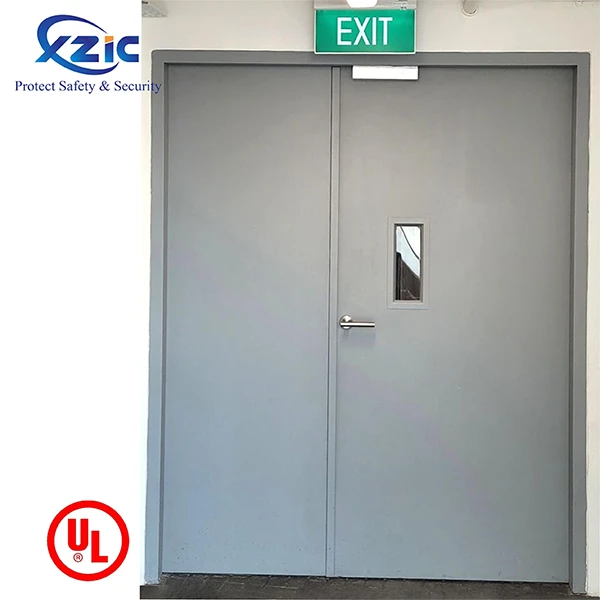

Now, let’s talk about testing, because that’s where all the claims about fire-retardant coatings are proven. Every steel fire door we manufacture, like our [Steel 36X80 Steel Fire Rated Door] models, goes through rigorous testing at third-party labs that follow strict standards. During a fire test, the door is heated to simulate a real fire, and its temperature is measured on the non-fire side. For a door to pass, the temperature on the non-fire side can’t rise more than 325°F above room temperature, and the door can’t have any gaps that would let smoke or fire through. The fire-retardant coating is a key factor in passing this test—if it didn’t perform, the steel would heat up too quickly, the door would warp, and it would fail.
As a steel fire door supplier, we take this responsibility seriously. We don’t cut corners on coating quality, because we know our doors protect people when they need them most. That’s why we only use coatings that are UL-listed and tested to the exact fire rating we advertise—no off-brand, untested coatings that might save a few dollars but fail in an emergency. We also work closely with architects, building managers, and contractors to help them choose the right coating type and fire rating for their specific project, whether it’s a small retail space, a large hospital, or a residential high-rise.
If you’re in the market for a steel fire door, it’s important to ask about the fire-retardant coating. Don’t just take a supplier’s word that the door is fire-rated—ask to see the test reports, confirm the type of coating used, and make sure it matches your building’s requirements. Our [Fire Rated Metal Door] line includes options for every application, from 60-minute interior doors to 180-minute exterior doors, all with tested, high-performance fire-retardant coatings.
At the end of the day, fire safety is non-negotiable. The fire-retardant coating on a steel fire door is the quiet workhorse that makes that door do its job. It’s not visible, it doesn’t add to the door’s cost significantly (when you compare it to the life safety it provides), and it’s tested to perform when every second counts. If you’re looking for a reliable steel fire door with a proven fire-retardant coating, our team is here to help. We can walk you through our product lines, answer any questions you have about coatings or fire ratings, and assist you with your procurement needs. Whether you need a 60-minute door for a stairwell or a 120-minute door for a commercial kitchen, we have the solutions you need to keep your building and its occupants safe.
Now, for reference, here are the standards and resources we rely on for all our fire door manufacturing:
- National Fire Protection Association (NFPA) 80: Standard for Fire Doors and Other Opening Protectives
- Underwriters Laboratories (UL) 10B: Standard for Fire Tests of Door Assemblies
- Underwriters Laboratories (UL) 10C: Standard for Fire Tests of Light Duty Vertical Slide and Swinging Door Assemblies
- International Building Code (IBC) 2021: Chapter 7, Fire Protection and Life Safety


